
Select a Language

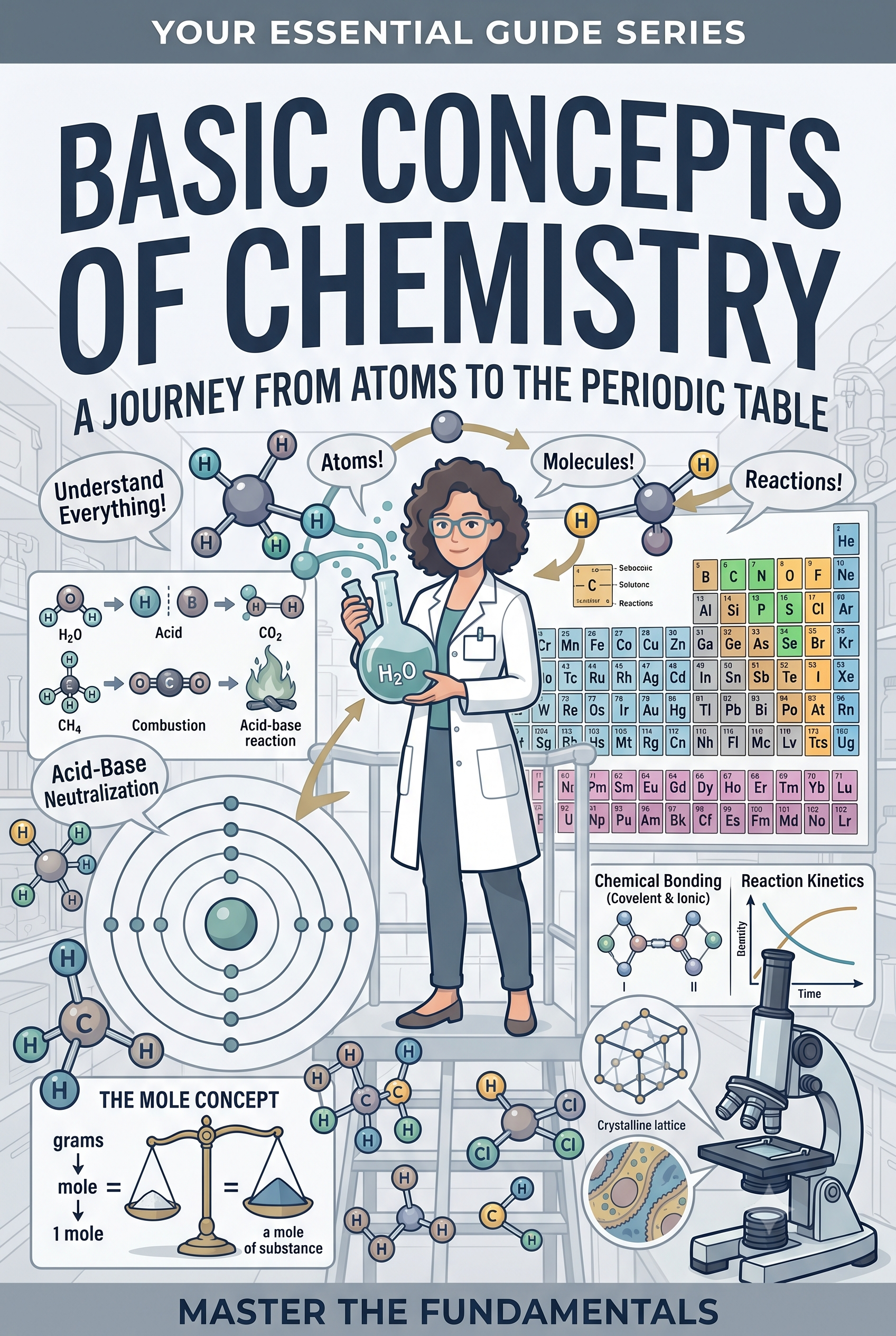
Basic Organic Chemistry Text Course
Instructor
About This Course
Basic Organic Chemistry Course – Complete Description
Basic Organic Chemistry is the foundation of almost every important concept that students encounter later in Organic Chemistry. This course is designed to help students build a strong conceptual understanding of the fundamental principles of Organic Chemistry before moving towards advanced and chapter-specific topics. It is especially useful for students preparing for JEE and NEET, as well as Class 11 and Class 12 students who want to strengthen their basics.
Organic Chemistry is not a subject that should be studied only through memorization. A strong understanding of concepts such as electronic effects, bonding, hybridization, resonance, acidity and basicity, reaction mechanisms, intermediates, and stereochemistry allows students to understand why a reaction takes place rather than simply remembering the reaction. This course focuses on developing that conceptual approach.
The course begins with the fundamentals of chemical bonding and structure in organic compounds, including covalent bonding, Lewis structures, formal charge, electronegativity, hybridization, bond polarity, sigma and pi bonds, and molecular geometry. These concepts form the basis for understanding the structure and reactivity of organic molecules.
A major focus of the course is General Organic Chemistry (GOC). Students learn how the arrangement and movement of electrons influence the properties and reactions of organic compounds. Important concepts such as inductive effect, resonance/mesomeric effect, hyperconjugation, electromeric effect, and steric effect are explained systematically. Students are trained to apply these concepts to compare the stability, acidity, basicity, and reactivity of different organic species.
The course also provides detailed coverage of reaction intermediates, including carbocations, carbanions, free radicals, and carbenes. Students learn how these intermediates are formed, what factors affect their stability, and how their stability influences reaction mechanisms and products. This helps students develop the ability to predict reaction pathways instead of relying purely on memory.
Another important component is acid-base chemistry in Organic Chemistry. Students learn how to compare the acidity and basicity of organic compounds using electronic effects, resonance, hybridization, and stability of conjugate species. These concepts are particularly important for solving JEE and NEET problems involving reaction mechanisms and compound comparisons.
The course also introduces students to types of organic reactions and reaction mechanisms, including substitution, addition, elimination, rearrangement, oxidation, and reduction. Rather than treating reactions as isolated facts, the course connects them with fundamental principles so that students can understand the logic behind the formation of products.
IUPAC nomenclature and structural representation are also covered to ensure that students can confidently interpret and write organic structures. Students practice different types of structural formulas, condensed structures, skeletal representations, and systematic naming. This is essential because difficulty in understanding structures can create problems in every subsequent Organic Chemistry chapter.
The course includes a dedicated focus on isomerism and stereochemistry, covering structural isomerism and the basic concepts of geometrical and optical isomerism. Students are introduced to the three-dimensional nature of organic molecules and learn how different spatial arrangements can affect the identity and properties of compounds.
Throughout the course, emphasis is placed on problem-solving and application of concepts. Questions are designed to move from basic conceptual understanding to JEE- and NEET-oriented application. Students get opportunities to identify reaction mechanisms, compare stability, predict products, analyze structures, and apply multiple concepts together.
Key Topics Covered
Introduction to Organic Chemistry
Classification of Organic Compounds
Structure and Bonding
Hybridization and Molecular Geometry
Sigma and Pi Bonds
Electronegativity and Bond Polarity
Formal Charge
IUPAC Nomenclature
Structural Representation of Organic Compounds
Inductive Effect
Resonance and Mesomeric Effect
Hyperconjugation
Electromeric Effect
Steric Effect
Acidity and Basicity
Stability of Organic Intermediates
Carbocations
Carbanions
Free Radicals
Carbenes
Nucleophiles and Electrophiles
Types of Organic Reactions
Reaction Mechanisms
Substitution, Addition and Elimination Reactions
Rearrangement Reactions
Introduction to Stereochemistry
Structural Isomerism
Geometrical Isomerism
Optical Isomerism
Concept-based and exam-oriented problem solving
Who Should Take This Course?
This course is suitable for Class 11 students, Class 12 students, droppers, and JEE/NEET aspirants who want to develop a strong foundation in Organic Chemistry. It is particularly beneficial for students who find Organic Chemistry confusing, struggle with reaction mechanisms, or tend to depend heavily on memorizing reactions.
By the end of the course, students should be able to approach Organic Chemistry with a more structured and logical mindset. The objective is not simply to complete the basics but to develop the conceptual foundation required for understanding advanced Organic Chemistry chapters and solving application-based questions confidently.
Strong basics make Organic Chemistry easier to understand, easier to revise, and easier to solve. This course is designed to build that foundation step by step and prepare students for the higher-level concepts and problems that follow.
Riya Joshi

Curriculum Overview
This course includes 0 modules, 0 lessons, and 0 hours of materials.
Course Specifications




Subscribe to Our Newsletter


Popular Categories
Previous Year Papers School Based Practice Test Part Syllabus Test Full Syllabus TestContact US


Reply to Comment